
CO₂ Laser Surgery for Dogs and Cats in Gdańsk
The laser cuts with light and immediately closes small blood vessels and nerve endings. This results in less bleeding and swelling during many procedures, allowing the surgeon to work more precisely on delicate tissues: in the nose, throat, eyelids, or oral cavity.
What is CO₂ laser
surgery?
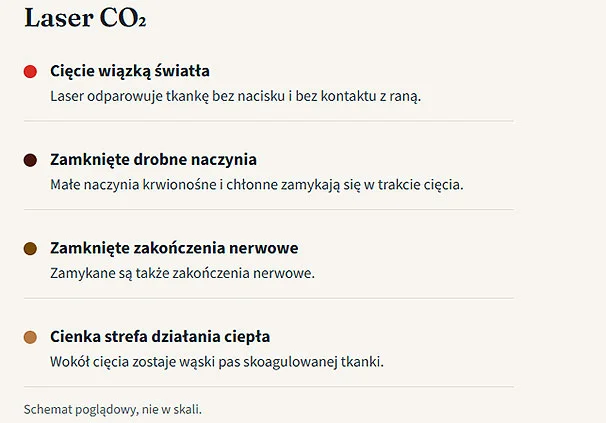
It involves making cuts and removing tissues using a carbon dioxide laser beam (wavelength 10,600 nm) instead of a scalpel. The laser energy vaporizes water in the cells while simultaneously closing small blood vessels, lymphatic vessels, and nerve endings.
The laser does not replace the surgeon; it is just one of their tools. The decision to use the laser, scalpel, or both for a particular patient is made by the doctor after examination.
What the laser offers your pet
Less bleeding
Small vessels are closed during the cut, making the surgical field cleaner.
Less swelling
Closed lymphatic vessels reduce swelling, which is important, for example, in the throats of brachycephalic dogs.
Precision with delicate tissues
The beam removes tissue layer by layer, for example, on the eyelid, in the nose, or on the gum.
Often shorter procedure
Less time spent controlling bleeding often means shorter anesthesia.
When the laser is not the best
choice
- Larger blood vessels need to be ligated; the laser will not close them.
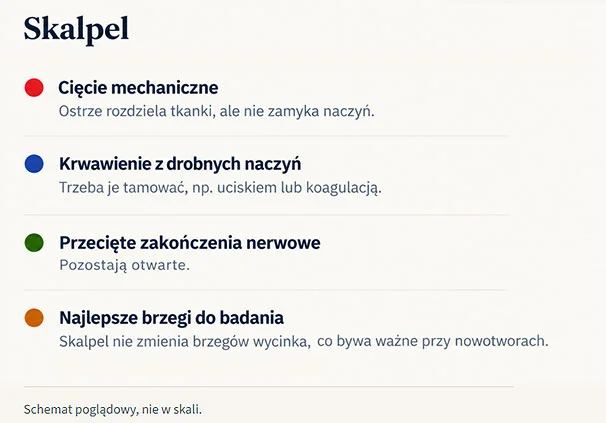
- When the margin around a tumor must be narrow, for example, on a finger or eyelid, the surgeon may use the laser or scalpel or combine both methods to ensure the tissue edges are fully readable for the histopathologist.
- Laser does not speed up skin healing. The effect depends on the surgeon’s technique and adherence to post-operative recommendations.
That is why we always choose the tool for the patient, not the other way around.
Scalpel vs. laser – what happens in the wound
Switch to see the difference in skin cross-section.
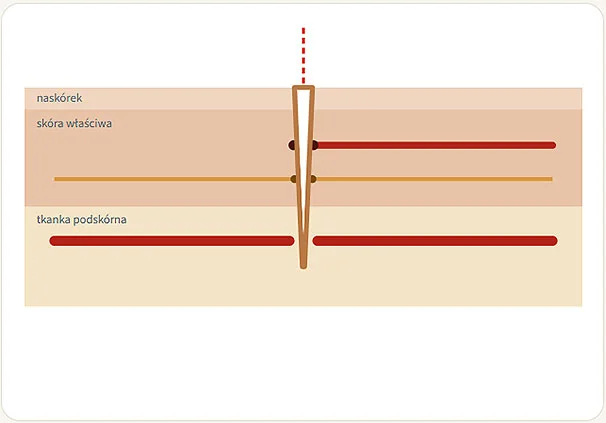
Illustrative diagram. Created by AI.
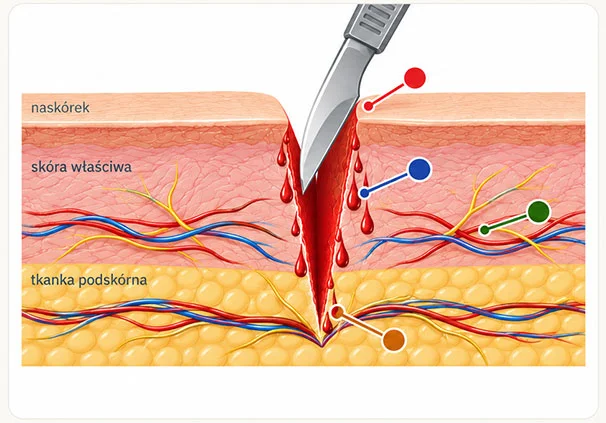
Illustrative diagram. Created by AI.
Procedures where we use laser
Select the area of the body. Each procedure has its own page with the course and recommendations.
Nose, throat, and larynx
Here the laser has the greatest advantage: in a narrow, well-vascularized space, it allows for cutting with less bleeding and swelling.
Nostril widening
In bulldogs, pugs, and Persian cats
Removal of everted laryngeal pockets
In advanced BOAS
Changes in the nasal cavity and throat
After diagnosis
Skin
Small nodules, papillomas, or cysts are removed precisely, often with a very small wound. The changes are sent for histopathological examination.
Eyes and eyelids
The eyelid is a thin, delicate tissue. The laser allows for the precise removal of the lesion exactly where needed.
Nodes on the edge of the eyelid
For example, Meibomian gland adenomas
More →
Oral cavity and gums
Gums and tongue are highly vascularized, so the laser helps maintain a clean surgical field. Laser procedures in the oral cavity are performed by dentist, Dr. Aleksandra Zalewska.
Gingivitis in cats
The most common laser procedure in dentistry
More →
Epulis
Changes on the gum
More →
Changes on the lips and tongue
With histopathological examination
More →
Anal region and others
Laser is also useful for changes in the anal region and in other places difficult to control bleeding.
Perianal adenomas
Common in older, unneutered dogs
More →
Fistulas and inflammatory changes
After qualification
More →
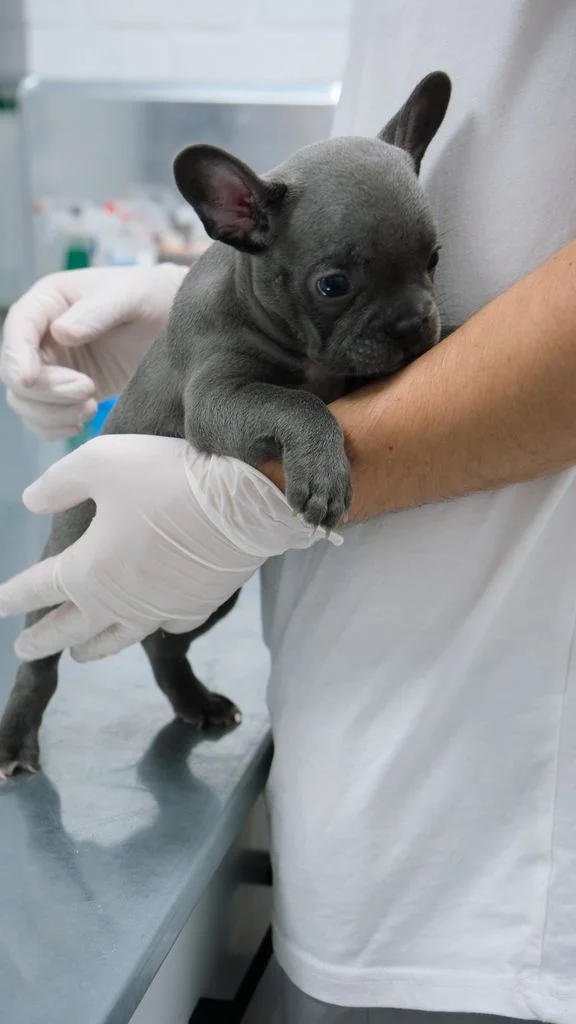
Laser in BOAS surgery in bulldogs and pugs
In brachycephalic dogs, we use laser to widen the nostrils and shorten the excessively long soft palate. In a comparative study on dogs with BOAS, CO₂ laser resulted in shorter surgery time and less bleeding than diode laser or electrocoagulation (Dunié-Mérigot et al., 2010).
Stay in the clinic
discharge the same day
Return to form
about 2–3 weeks
After the procedure
control and recommendations in writing
How we ensure safety during laser procedures
A surgical laser is a high-power device. Therefore, every procedure follows the same protocol.
Eye protection
Examination, discussion of the purpose of the procedure, risks, alternatives, and costs.
Smoke evacuation
Blood tests, and if necessary, X-rays, ultrasound, or echocardiogram. Anesthesia plan tailored to the patient.
Safe preparation of the field
Surgery under general anesthesia with monitoring of vital parameters and pain management.
Full monitoring
The pet wakes up under the care of the team. We will call you after the procedure.
CO₂ Surgical Laser 30 W
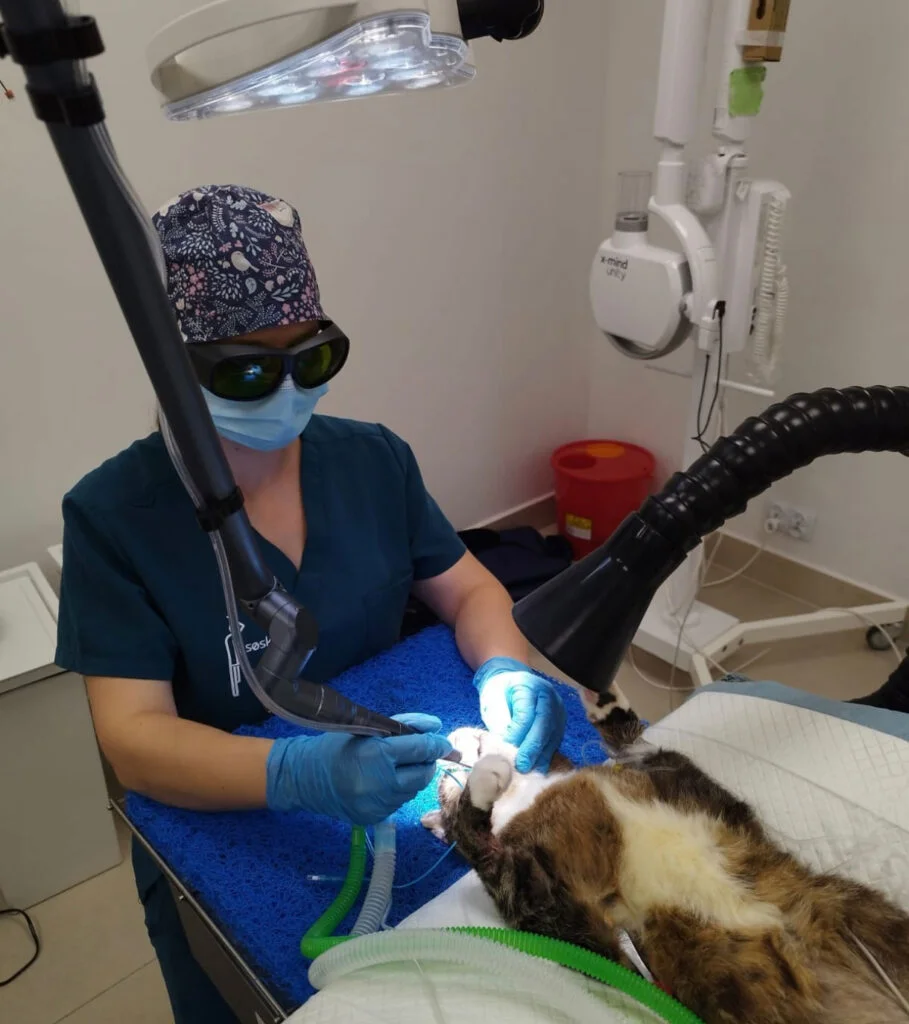
Model – NWAY F12
Type of laser – CO₂, surgical
Power – 30 W
Wavelength – 10 600 nm
Equipment is half the success.
The other half is the surgeon.

Małgorzata Szczepańska
veterinarian
Surgery, orthopedics, ultrasound
Training in laser surgery · Finemed
Completed training in laser surgery conducted by Finemed. Performs surgical procedures on dogs and cats

Aleksandra Zalewska
veterinarian
Stomatology – Laser in the oral cavity – Uses laser in dental procedures, most often for gum inflammation in cats.
Questions about laser procedures
Do you have another question?
Call, and the doctor will explain whether the laser will be suitable for your pet.
FAQ – questions and answers
Based on research
Dunié-Mérigot A. et al. (2010), Veterinary Record
Comparison of CO₂ laser, diode laser, and electrocoagulation in shortening the soft palate in dogs with BOAS. – doi: 10.1136/vr.c5107 →
Pieper J. (2023), In Practice
Review of the applications of surgical lasers in small animal dermatology. – doi: 10.1002/inpr.288 →
Let’s talk about your pet’s procedure
Surgical consultation is a calm conversation: examination, plan, risk, and cost – before you make a decision