
Suturing wounds and treating bites in dogs and cats in Gdańsk – 24 hours a day
Has your dog been bitten, did your cat come home with a wound, or did your pet cut its paw? Don’t wait until morning. We help 24/7: we stop the bleeding, relieve pain, and check what lies beneath the skin. A bite wound often looks innocent, but a small hole can hide extensive damage.
Content author: veterinarian Małgorzata Szczepańska
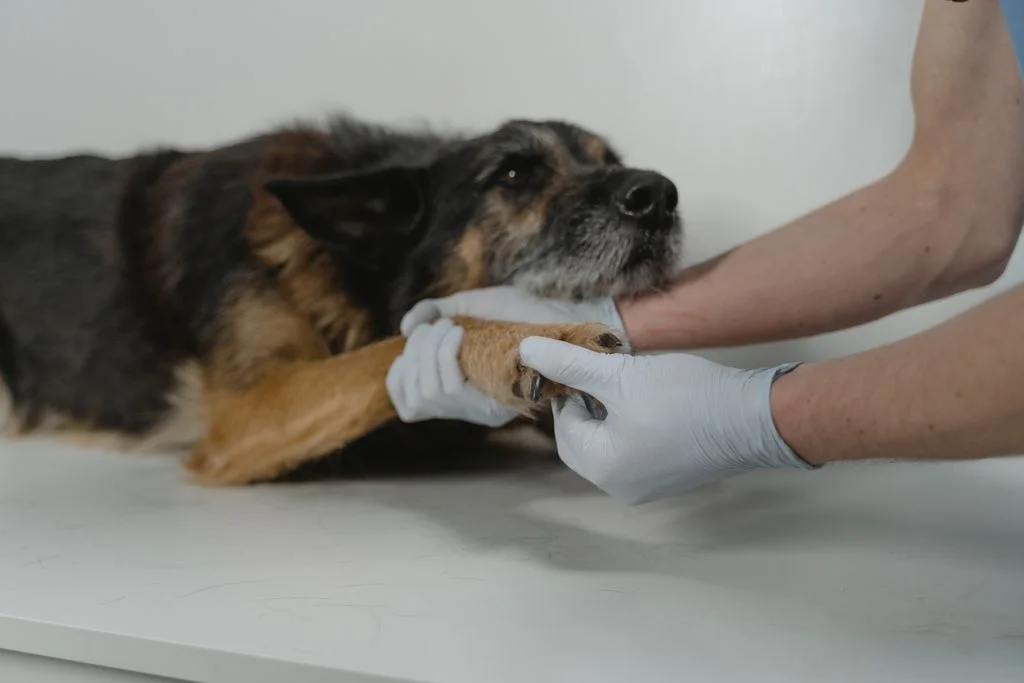
How are wounds and bites treated in dogs and cats?
The veterinarian first assesses the overall condition of the pet and administers pain relief medication. Then, usually under sedation or anesthesia, they shave the area around the wound, thoroughly rinse it, and remove dead tissue and debris.
Next, the surgeon decides whether to stitch the wound immediately, after a few days, or to allow it to heal under a dressing. In cases of deep bites, a drain is often placed to remove fluid from the wound.
What to do before you arrive
1
Ensure safety
Pain can cause even a mild pet to bite. Approach calmly. Do not put on a muzzle if the animal has a mouth wound or difficulty breathing.
2
Apply pressure to the bleeding area
Place a clean gauze or towel and apply pressure for a few minutes. When it becomes soaked, do not remove it – add another layer.
3
Cover the wound
Cover it with a clean bandage. You can rinse it with lukewarm water or saline. Do not pour hydrogen peroxide or alcohol, and do not apply ointments.
4
Call and come
Transport small animals in a carrier, large dogs on a blanket. Take the health booklet with vaccination information against rabies.
Go immediately if
- the wound is on the chest, abdomen, or neck,
- the pet is breathing heavily or there is hissing from the wound,
- bleeding does not stop despite pressure,
- muscles, bone, or organs are visible in the wound,
- the pet is weak, pale, cold to the touch,
- a large dog has bitten a small dog or cat.
Why a small wound from a bite can be dangerous
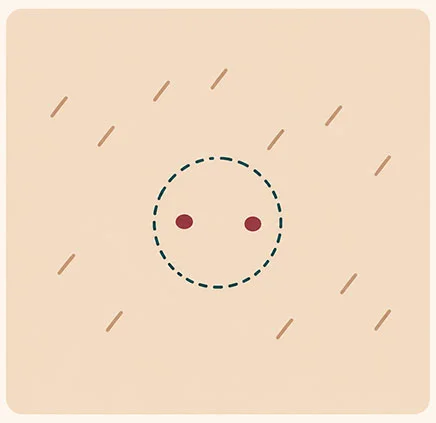
Illustrative diagram. Created by AI.
What you see
On the skin, you often only see two small wounds from the fangs. They do not bleed much, and the pet behaves normally after a while. It is easy to assume that nothing happened.
The urgency of the visit depends on the depth of the wound, its extent, and the area of the body. In case of doubt, we invite you – it is better to check than to wait.
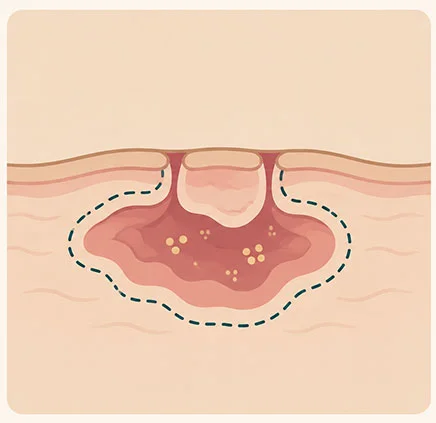
Illustrative diagram. Created by AI.
What is under the skin
Under the skin, things can be quite different. The skin is elastic and moves, while the tissues beneath it get crushed and torn. Bacteria from the oral cavity enter the created pocket. Without treatment, an abscess or extensive infection may develop.
The urgency of the visit depends on the depth of the wound, its extent, and the area of the body. If in doubt, we invite you – it’s better to check than to wait.
What wounds do we treat
Choose the type of wound to see what to watch out for and how we proceed. The urgency and method of treatment depend on the depth of the wound and the area of the body – it is assessed by a doctor after examination. If in doubt, we invite you.
Dog bite
Bite wound – punctured, crushed, and torn at the same time
What is happening
Fangs pierce the skin, and jaws crush and tear the tissues beneath. The neck, chest, abdomen, and legs are most often affected. Bacteria from the oral cavity enter the wound.
What to watch out for
Small wounds from fangs, swelling, pain upon touch. Dangerous signs include difficulty breathing, weakness, and wounds on the chest or abdomen.
What we do
We assess the overall condition and, if necessary, perform X-rays or ultrasounds. Under anesthesia, we flush the wound, check its extent, and remove dead tissue. We often place a drain. The decision about antibiotics is made by the veterinarian.
Abscess after a cat bite
Typical after fights between outdoor cats
What is happening
Cat teeth are thin as needles. The wound quickly seals and traps bacteria inside. After a few days, a painful abscess forms in that spot.
What to watch out for
Painful swelling, limping, fever, lethargy, loss of appetite. The abscess may burst on its own and ooze a foul-smelling discharge.
What we do
We open and flush the abscess, sometimes placing a drain. For outdoor cats after a bite, it is worth discussing tests for FIV and FeLV.
Cut wound
Glass, metal, sharp edges
What is happening
A wound with smooth edges. It can be deep and may damage vessels, nerves, or tendons, especially on the paws.
What to watch out for
Severe bleeding, limping, the pet does not put weight on the paw or places it unnaturally.
What we do
After thoroughly cleaning, fresh cuts are usually stitched immediately. We check for damaged tendons and vessels.
Paw pad wound
Most often after stepping on glass or a sharp object
What is happening
The pad is thick and constantly loaded when walking. Therefore, it heals slower than skin, and stitches are more likely to come apart.
What to watch out for
Bleeding with every step, limping, licking the paw.
What we do
We stitch the wound and apply a dressing that relieves pressure on the pad. Regular dressing changes are usually needed.
Torn or extensive wound
Hit by a car, snagged on a fence or wire
What is happening
Tearing of the skin over a large area, often dirty with dirt or gravel. It may be associated with other injuries, such as fractures.
What to watch out for
Large skin loss, wound contamination, shock symptoms: pallor, rapid breathing, weakness.
How we proceed
First, we stabilize the patient and relieve pain. Contaminated wounds are usually treated in stages: rinsing, dressings, and stitching only when the wound is clean.
Sew immediately or wait? The surgeon decides
Not every wound can be safely stitched immediately. Closing a contaminated wound may trap bacteria inside. The surgeon chooses the method after assessing how deep, clean, and fresh the wound is.
Sewing immediately
For fresh, clean wounds, such as cuts, after thorough cleaning. The shortest path to healing.
Delayed sewing
When the wound is contaminated or at risk of infection. First, a few days of rinsing and dressings, then stitching.
Healing under a dressing
Some wounds can be treated under a dressing, without stitching. Dressings are changed regularly until the wound heals.
Drain
A thin tube drains fluid from deep bite wounds to prevent abscess formation. We remove it after a few days.
What happens after arrival – step by step
First, we save and relieve pain, then we carefully treat the wound. At each stage, we tell you what comes next.
1
Quick assessment
We check breathing, circulation, and bleeding. The most urgent cases are accepted immediately.
2
Pain relief
We relieve pain and, if necessary, stabilize the pet, e.g., with intravenous fluids.
3
Diagnostics
For chest, abdomen, or neck wounds, we perform X-rays or ultrasounds and blood tests.
4
Wound treatment
Under sedation or anesthesia, we clean the wound, remove dead tissue, and then stitch, place a drain, or apply a dressing.
5
Home or observation
For smaller wounds, the pet usually returns home the same day. More serious cases remain under the clinic’s care.
What you should know about wound treatment
- A bite wound always contains bacteria from the mouth. Even with proper treatment, it can become infected, which is why follow-ups are so important.
- Larger and contaminated wounds are often treated in stages: several dressing changes may be needed, and sometimes a second procedure.
- A bite to the chest or abdomen can damage internal organs, even if the skin looks fine. Surgery may be necessary in such cases.
- A scar may remain at the wound site, and fur may sometimes regrow in a different color.
Wound care at home
Collar or outfit
Protects the wound and stitches from licking and scratching. Wear it until the doctor allows you to remove it.
Dressing and drain
The dressing should be clean and dry. Do not remove the drain. A small amount of fluid drainage from the drain is normal.
Medications as prescribed
Administer painkillers and – if prescribed by the doctor – antibiotics until the end, even if the wound looks good.
Check-ups and suture removal
During the check-up, we check the healing and change the dressing. Skin sutures are usually removed after 10–14 days.
Call immediately if:
- swelling around the wound increases or is hot,
- pus is leaking from the wound or it has an unpleasant smell,
- the wound has opened, the drain has fallen out, or the dressing has soaked through,
- your pet is not eating, is lethargic, or has a fever,
- there are difficulties breathing.
Wounds and bites are treated by our team of surgeons



Questions about wounds and bites
Not sure if a wound needs stitching? The urgency depends on the depth of the wound and the area of the body. If in doubt, feel free to call or come by.
FAQ – questions and answers
Based on the research
Pavletic M.M., Trout N.J. (2006), Veterinary Clinics of North America: Small Animal Practice
Review of the treatment of gunshot wounds, bites, and burns in dogs and cats – why bite wounds can be much more serious than they appear on the skin. – PubMed 16787791 →
Kalnins N.J. et al. (2022), Journal of Veterinary Internal Medicine
Analysis of 1526 cases of dog bites by other dogs: how wounds were treated and when antibiotics were used. The authors recommend responsible, targeted use of antibiotics. – doi: 10.1111/jvim.16574 →
Frykfors von Hekkel A.K. et al. (2020), Veterinary Surgery
Analysis of 123 dogs with bite wounds to the chest – why bites in this area require thorough diagnostics and evaluation by a surgeon. – doi: 10.1111/vsu.13402 →
Does your pet have a wound? We are here 24/7
Call, tell us what happened, and come in. We will take care of the pain, the wound, and what is not visible.