
Gastric torsion in dogs – surgery in Gdańsk, available 24/7
Is your dog trying to vomit but nothing comes up, drooling, restless, and its belly is rapidly swelling? These could be symptoms of gastric torsion – an emergency condition where every minute counts. Don’t wait until morning.
If in doubt, call and come in – we operate 24/7.
Content author: veterinarian Małgorzata Szczepańska
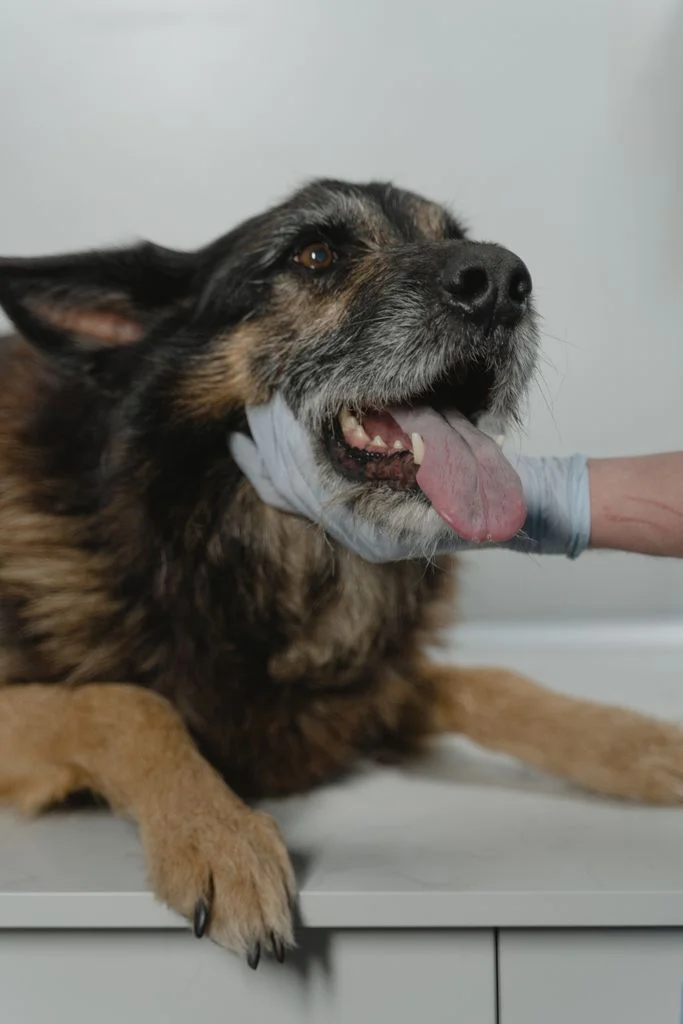
What is gastric torsion and how is it treated?
Gastric torsion (GDV – gastric dilation and volvulus) is a condition where the stomach fills with gas and then twists around its axis. The gas has no outlet, the enlarged stomach compresses major vessels, and circulation in its wall and the spleen is disrupted. Shock develops rapidly.
Treatment involves stabilizing the dog, decompressing the stomach, and urgent surgery: the veterinarian positions the stomach correctly, assesses its wall and the spleen, and then sutures the stomach to the abdominal wall (gastropexy) to reduce the risk of recurrence.
Gastric dilation and torsion
The stomach fills with gas and fluid, but is not yet twisted. This is already an emergency: the enlarged stomach compresses the diaphragm and blood vessels, and torsion can occur at any moment. Whether the stomach has twisted is assessed by the veterinarian via X-ray – it cannot be distinguished at home.
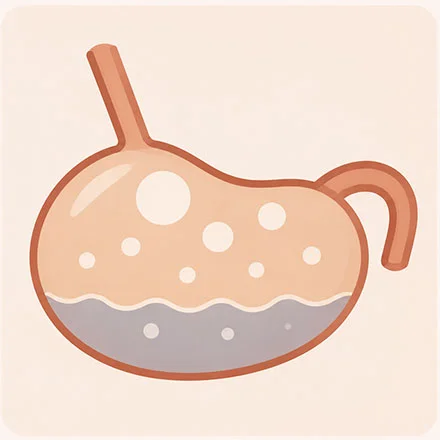
Illustrative diagram. Created by AI.
Dilation
The stomach fills with gas and fluid, but is not yet twisted. This is already an emergency: the enlarged stomach compresses the diaphragm and blood vessels, and at any moment it can twist. Whether the stomach has twisted is assessed by the doctor on an X-ray – it cannot be distinguished at home.
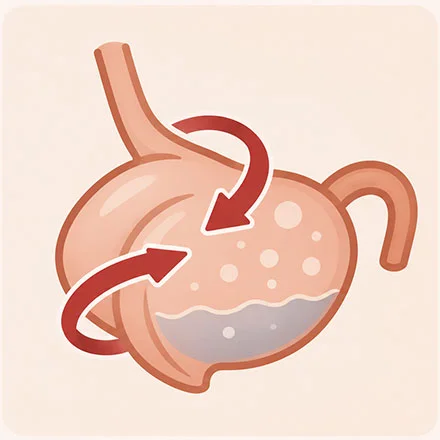
Illustrative diagram. Created by AI.
Twist
The stomach rotates around its axis and closes its entrance and exit. Gas has no outlet, the stomach wall and spleen are increasingly poorly perfused, and shock develops. Without quick surgery, a part of the stomach wall may die. Urgent help is needed – even at night.
SYMPTOMS OF STOMACH TWIST
- attempts to vomit without content or with a small amount of foam,
- excessive salivation,
- enlarged, hard abdomen – especially behind the ribs,
- restlessness, pacing, the dog cannot lie down,
- rapid breathing, panting,
- weakness, pale gums, fainting.
Symptoms appear suddenly, often after eating or drinking and in the evening or at night. They most often affect large and giant breeds with deep chests, such as Great Danes, German Shepherds, Setters, Weimaraners, St. Bernards, and Dobermans – but can also occur in other dogs.
Go immediately if:
- the dog tries to vomit but brings nothing up,
- the abdomen quickly enlarges and is tense,
- the dog is drooling, restless, and cannot lie down,
- it is weak, has pale gums, or collapses.
Do not give food, water, or medication and do not wait to see if it will “pass.” Call that you are coming – we will prepare for your arrival.
How we treat stomach twist
Time is of the essence in a stomach twist. First, we save circulation and decompress the stomach, then we operate as quickly as possible. The method of treatment is always determined by the doctor after examination.
Diagnostics
Clinical examination and X-ray of the abdominal cavity show whether the stomach is only enlarged or already twisted. The dog’s condition is assessed based on clinical examination, imaging studies, and blood tests.
Stabilization
Intravenous fluids, pain medications, and oxygen. Decompression of the stomach to reduce pressure.
Operation
Positioning the stomach correctly and assessing its wall and the spleen. If a part of the wall or the spleen is damaged, the doctor may remove it.
Gastropexy
Suturing the stomach to the abdominal wall. It does not prevent dilation but significantly reduces the risk of volvulus recurrence.
What happens after arrival – step by step
1
Phone and arrival
Call to let us know you are coming – the team will prepare for your arrival.
2
Examination and X-ray
We assess circulation, breathing, and the abdomen. An X-ray confirms the diagnosis.
3
Stabilization
Fluids, medications, and stomach decompression – preparation for safe anesthesia.
4
Operation
Stomach twisting, organ assessment, and gastropexy. Also at night and on weekends.
5
Post-operative care
The dog may remain under 24-hour care at the clinic with EKG monitoring. The decision is made by the veterinarian.
Preventive gastropexy and daily habits
In dogs of breeds at risk, gastropexy can be performed preventively – planned, for example, during sterilization or castration. A review from 2022 recommends considering such a procedure for particularly at-risk breeds.
If in doubt, we invite you for a consultation.
- a few smaller meals instead of one large one,
- calm before and after eating – without intense movement,
- a slow feeder bowl if the dog eats very quickly,
- a bowl on the floor, not elevated.
Gastropexy
recommended to consider for breeds at risk (Rosselli, 2022)
What you should know
- Stomach twisting is one of the most serious emergencies in dogs. The chances are greater the sooner the dog reaches the clinic.
- The prognosis primarily depends on the condition of the stomach wall. Blood tests, e.g., lactate levels, help assess the situation but do not determine the outcome – therefore, treatment is decided by the veterinarian after examination.
- In the first days after surgery, heart rhythm disturbances may occur. Therefore, we monitor the patient and their EKG.
- Without gastropexy, stomach twisting often recurs. After gastropexy, the stomach may still expand, but the risk of twisting is significantly lower.
Upon returning home
- small portions of easily digestible food several times a day,
- calm walks on a leash for about 2 weeks,
- clothing or collar for removing stitches,
- medications exactly as prescribed and a follow-up visit.
Call if the dog tries to vomit again, the abdomen is enlarging, the dog is weakening, or the wound is red and oozing.
Stomach twisting surgeries – 24 hours


Questions about gastric torsion
Is your dog behaving strangely after eating, and does its belly look different than usual?
If in doubt, call – we will help assess whether you need to come in right away.
FAQ – questions and answers
Based on research
Glickman L.T. et al. (2000), Journal of the American Veterinary Medical Association
Risk factors for gastric torsion in large and giant breed dogs – including age, history of gastric torsion in relatives, rapid eating, and feeding methods. – doi: 10.2460/javma.2000.217.1492 →
Mackenzie D. (2022), Veterinary Evidence
Review of 15 studies: blood lactate levels help in discussing prognosis, but do not determine the outcome for a specific dog – surgery is recommended regardless of its values. – Read the review →
Rosselli D. (2022), Veterinary Clinics of North America: Small Animal Practice
Current review of knowledge on gastric torsion and gastropexy, including preventive gastropexy in breeds at risk. – doi: 10.1016/j.cvsm.2021.11.004 →
Is your dog trying to vomit, and is its belly swelling? Go immediately
Call and come in. We accept and operate 24 hours a day.