
Abscesses and fistulas in dogs and cats – treatment in Gdańsk
Painful, hot swelling a few days after a fight with another animal? A wound that heals and then opens up again and oozes? This could be an abscess or a fistula. Do not puncture or squeeze them at home. An abscess needs to be opened, cleaned, and its cause found – otherwise, it will return.
Content author: veterinarian Małgorzata Szczepańska
What is the difference between an abscess and a fistula?
An abscess is a closed cavity filled with pus. It most often occurs after a bite when bacteria are trapped under the skin. Treatment involves opening, cleaning, and flushing the abscess.
A fistula is a channel that oozes onto the skin from time to time. Usually, there is a cause deep within, such as a grass awn, a splinter, or a diseased tooth. A fistula heals only after the cause is removed.
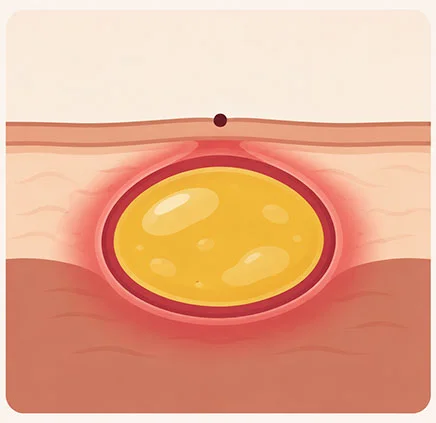
Illustrative diagram. Created by AI.
Why do abscesses and fistulas return?
An abscess is a closed pocket of pus. If it is only punctured or bursts on its own, it often fills up again. Only thorough opening, flushing, and sometimes drainage allow it to heal.
That is why for every abscess and every fistula, we look for the cause, not just treat what is visible on the skin.
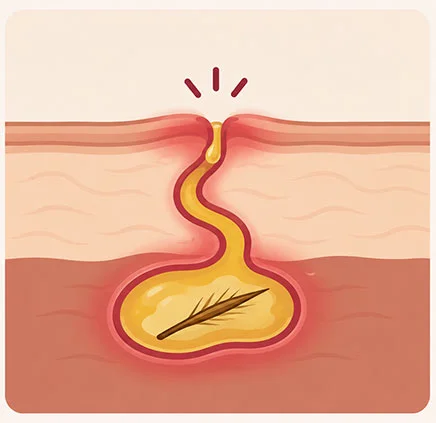
Illustrative diagram. Created by AI.
Why abscesses and fistulas return
A fistula is a channel through which the body tries to get rid of something that is stuck deep inside – e.g., a blade of grass. A wound on the skin may close, but after a few days or weeks, it starts to ooze again.
That is why, with every abscess and every fistula, we look for the cause, not just treat what is visible on the skin.
Dog attacked by a wild boar – what to do
Wild boars regularly appear in the districts of Gdańsk bordering forests, e.g., in Oliwa, Osowa, Matarni, or Jasień. An encounter between a dog and a wild boar, especially with a sow leading young, can result in serious injuries.
The tusk of a wild boar acts like a knife: it leaves deep, jagged wounds, most often in the groin, abdomen, chest, and thighs. The wounds are heavily contaminated with dirt and bacteria, which is why abscesses often form in them after a few days. A wild boar can also hit or crush a dog – this can lead to internal injuries without a large wound on the skin.
AFTER ENCOUNTERING A WILD BOAR
- Call your dog back and walk away calmly. Do not try to scare the wild boar away.
- Examine your dog, parting the fur – wounds from tusks can be easily overlooked.
- Apply pressure to the bleeding area with a clean cloth.
- Come to the clinic, even if you do not see a wound. Internal injuries may not show symptoms right away.
Leash at dusk and in the forest
Wild boars are most active in the evening, at night, and early in the morning. On a leash, a dog cannot chase a wild boar.
Beware of sows with piglets
A female protecting her young is the most likely to attack. If you see striped piglets, turn back.
Do not feed wild boars
Food scraps and open trash cans attract wild boars to neighborhoods and gardens.
Where abscesses and fistulas come from
Select a cause to see how to recognize it and how we treat it. Diagnosis is always made by a veterinarian after examination.
Where it comes from
The teeth of a cat or dog introduce bacteria deep under the skin. A small wound quickly seals up, and bacteria multiply inside. After a few days, an abscess forms.
What you will notice
Painful, warm swelling, most often on the paw, at the base of the tail, on the neck, or head. Fever, lethargy, loss of appetite, lameness.
How we proceed
We open and flush the abscess, and for larger ones, we place a drain. For outdoor cats, it is worth discussing tests for FIV and FeLV, which are transmitted, among other ways, through bites.
Wound and abscess after a wild boar attack
Wounds from tusks, often with blunt trauma
Where it comes from
The wild boar’s tusk tears the skin and muscles, and the wound is heavily contaminated with dirt and bacteria. Such wounds easily turn into abscesses, even when they look innocuous on the surface.
What you will notice
Torn wounds in the groin, abdomen, chest, or thighs. After a few days, swelling, pain, and fever increase. After the impact – lameness, difficulty breathing, weakness.
How we proceed
We assess the general condition, and if necessary, we perform X-rays and ultrasounds. Under anesthesia, we thoroughly clean and treat wounds, and we place drains. Extensive wounds are often treated in stages.
Foreign body – grass awn
Migrating awn, splinter, or other foreign body
Where it comes from
The awn penetrates the skin, most often between the toes, and thanks to its barbs, it migrates deeper. The body tries to expel it, forming an abscess and a fistula.
What you will notice
Swelling between the toes, licking of the paw, a fistula that oozes and recurs despite treatment. The awn can also end up in the ear, nose, or groin.
How we proceed
We look for the awn in the ultrasound and remove it surgically. In X-rays, the awn is usually not visible. After the foreign body is removed, the fistula usually heals.
Tooth abscess
Swelling or fistula under the eye or on the cheek
Where it comes from
Infection of the root of a broken or diseased tooth can break through the bone and skin. A common example is an abscess of the fourth premolar in a dog, visible as swelling under the eye.
What you will notice
Swelling under the eye or on the cheek, an oozing wound that recurs, reluctance to bite, unpleasant odor from the mouth.
How we proceed
Treatment requires a dental procedure – removal or treatment of the diseased tooth. Simply opening the abscess is not enough.
Perianal Fistulas
Chronic inflammatory disease of the anal area
Where it comes from
An immunological disease in which painful channels and ulcers form around the anus. It most commonly affects German Shepherds.
What you will notice
Licking of the anal area, pain during defecation, bleeding, unpleasant odor, ulcers around the anus.
How we proceed
Treatment usually starts with medication, often for a long duration. Surgical intervention is considered for selected patients.
Fistula after previous surgery
E.g. reaction to suture material deep in the tissues
Where it comes from
Rarely, the body reacts to suture material or other foreign bodies left in the tissues. A chronic fistula may develop in this area, even long after the procedure.
What you will notice
A draining wound in the area of the old scar, which heals and opens again.
How we proceed
We diagnose the cause with ultrasound, and then surgically remove the fistula channel along with the foreign body.
How we treat abscesses and fistulas
An antibiotic alone is usually not enough. The pus must have an outlet, and the cause must be removed. The extent of the procedure is determined by the veterinarian after examination.
Opening and rinsing
Under sedation or anesthesia, we open the abscess, remove the pus and dead tissue, and thoroughly rinse the cavity.
Drain
For larger abscesses, we place a drain so that the discharge can flow freely and the abscess does not recur.
Finding the cause
Ultrasound and X-ray help find foreign bodies or changes deep in the tissues. In case of recurrences, we take a swab for culture with an antibiogram.
Removing the cause
We remove the foreign body or surgically excise the fistula tract along with the affected tissue.
Step-by-step treatment
At every stage, you know what is happening and what comes next.
1
Examination
We assess the swelling or fistula, general condition, and fever. We ask what happened.
2
Diagnostics
Ultrasound, X-ray, and if necessary, blood tests and culture with antibiogram.
3
Procedure
Opening and flushing of the abscess, removal of a foreign body, or excision of a fistula. Often with a drain.
4
Home treatment
Pain relievers and – if the doctor recommends – antibiotics. Wound and drain care.
5
Follow-up
Removal of the drain, assessment of healing, and checking if the lesion does not return.
What to know before treatment
- The fistula returns as long as its cause remains deep within the tissues. Sometimes more than one procedure is needed.
- A grass awn can migrate in the tissues, and it is usually not visible on X-rays. Finding it can be difficult and may require several imaging studies.
- Wounds from a wild boar attack are heavily contaminated. Even with proper treatment, they may require several dressing changes or reprocessing.
- Do not squeeze or puncture the abscess at home – you may push bacteria deeper and injure your pet.
Care after abscess treatment
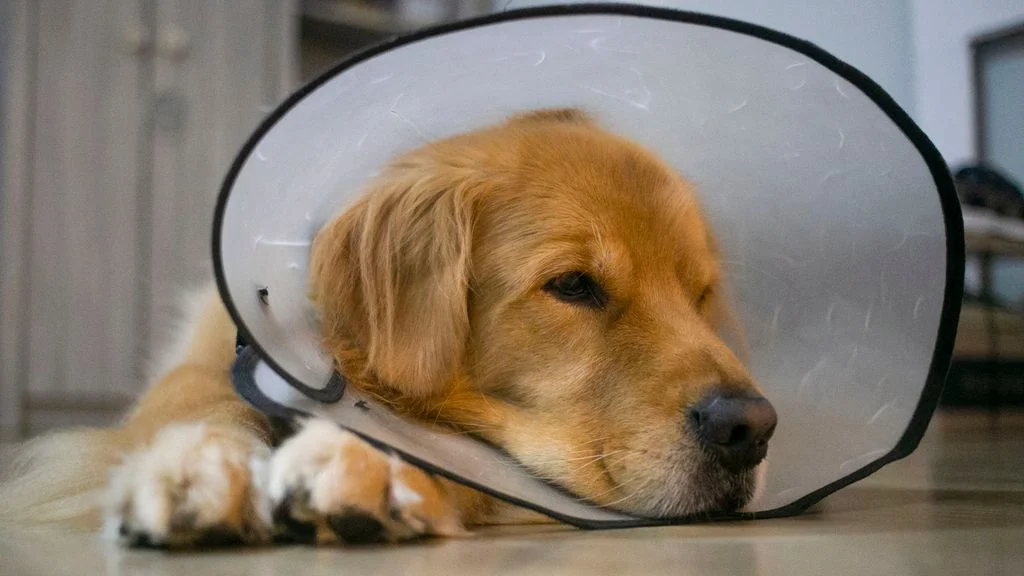
Collar or clothing
Protects the wound and drain from licking and scratching.
Discharge from the wound is often a good sign
For the first few days, fluid may drain from the wound or drain. Gently clean the skin as directed.
Medications to the end
Pain relievers and – if the doctor prescribed them – antibiotics should be given until the end, even if the swelling disappears.
Drain Control and Removal
We usually remove the drain after a few days. During the check-up, we verify if the wound is healing properly.
Call immediately if:
- the swelling increases again or appears in a new location,
- your pet has a fever, is not eating, or is lethargic,
- the drain has fallen out or the wound is bleeding heavily,
- the area that healed has started to ooze again.
Abscesses and Fistulas Treated by Our Surgical Team



Questions about abscesses and fistulas
Swelling that does not go away, or a wound that keeps oozing?
If in doubt, we invite you.
FAQ – questions and answers
Based on research
Surleraux C. et al. (2025), Journal of the American Animal Hospital Association
Analysis of 42 dogs after a wild boar attack: puncture wounds from tusks, blunt trauma, and mixed injuries. Over 90% of dogs survived treatment, and blunt injuries were sometimes more dangerous than the wounds themselves. – doi: 10.5326/JAAHA-MS-7502 →
Caivano D. et al. (2023), Animals
Systematic review: Ultrasound helps locate and remove migrating grass awns in dogs and cats, and in harder-to-access areas, it is worth combining them with other imaging studies. – doi: 10.3390/ani13132071 →
Pavletic M.M., Trout N.J. (2006), Veterinary Clinics of North America: Small Animal Practice
Review of the treatment of bite wounds in dogs and cats – why bite wounds can be more serious than they appear and are easily infected. – PubMed 16787791 →
Swelling that doesn’t go away? Let’s check the cause
Schedule an appointment, and after an encounter with a wild animal or in case of fever – call and come immediately.