
Splenectomy in dogs and cats – surgery in Gdańsk
Was a change detected in the spleen on ultrasound, or has the dog suddenly become weak and has pale gums? We will explain what the result means, and – if necessary – we will perform the surgery, even at night.
If in doubt, we invite you to consult.
Content author: veterinarian Małgorzata Szczepańska
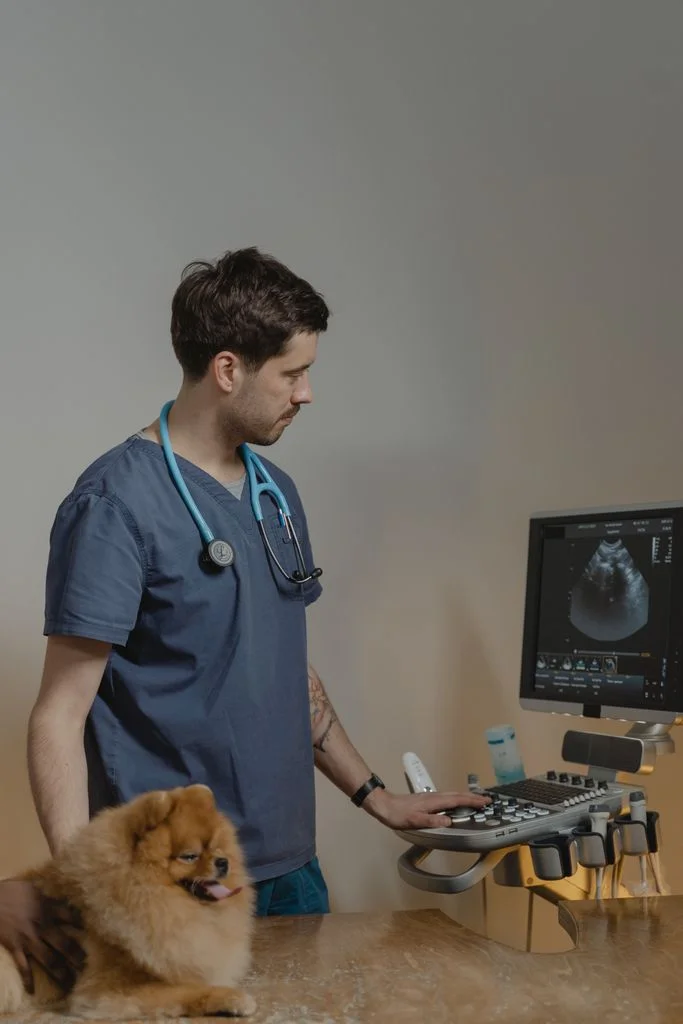
What is a splenectomy and when is it needed?
The spleen is an organ in the abdominal cavity that filters blood and stores blood cells. Older dogs often develop nodules, tumors, or hematomas on it. Not every such change is a malignant tumor, but many of them can rupture and bleed.
Splenectomy is the removal of the entire spleen. Dogs and cats can live without this organ. The final diagnosis is provided by histopathological examination of the removed spleen – results are obtained within a few days to 4 weeks.
Change in the spleen: calmly or urgently?
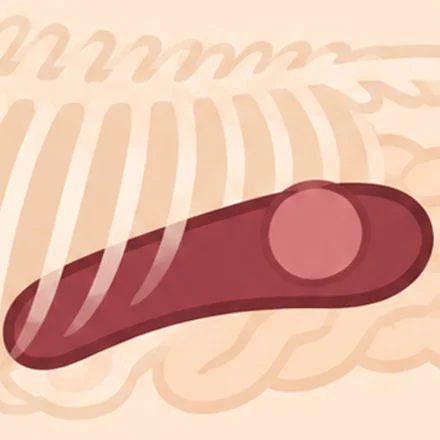
Illustrative diagram. Created by AI.
Unruptured change
The change is often detected incidentally, for example during an ultrasound for another reason, and the dog feels well. There is no need to go at night, but it is worth not delaying the consultation. The doctor will assess the change, order necessary tests, and propose a plan. In studies, most unruptured changes in the spleen turned out to be benign.
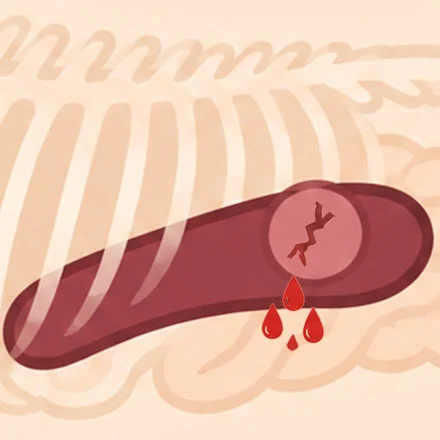
Illustrative diagram. Created by AI.
Bleeding
A tumor or hematoma of the spleen has ruptured and is bleeding into the abdominal cavity. The dog suddenly weakens, has pale gums, rapid breathing, and the abdomen may be swelling. This is an emergency: stabilization is needed, often a blood transfusion and urgent surgery.
WHEN THE SPLEEN IS REMOVED
- spleen tumor or nodule – benign or malignant,
- spleen hematoma,
- spleen rupture, e.g., after a collision,
- spleen torsion – independent or with stomach torsion,
- infarction or thrombosis in the spleen,
- selected cases of significant spleen enlargement.
The decision for surgery is always made by the veterinarian after examination and diagnostics. Not every change in the spleen requires removal of the organ – sometimes an ultrasound control is sufficient.
Go immediately if:
- the dog suddenly weakens, faints, or falls over,
- has pale gums and cold paws,
- is breathing rapidly, and the abdomen is swelling,
- has had an injury, e.g., a collision – even if it looks fine.
Bleeding from the spleen can be hidden – there is no visible blood outside. Call that you are coming.
What treatment looks like
The procedure depends on whether the change is bleeding. In case of bleeding, we first save circulation; if the change is detected incidentally, we have time for full diagnostics. The plan is always tailored by the veterinarian after examination.
Diagnostics
Abdominal ultrasound, blood tests, and coagulation tests, chest X-ray. If necessary, additional imaging tests.
Stabilization
Intravenous fluids and medications. In case of bleeding, a blood transfusion from our blood bank.
Surgery
Removal of the entire spleen under general anesthesia with full monitoring. The veterinarian also assesses the remaining organs in the abdominal cavity.
Histopathology
The removed spleen is sent for examination. The result – from a few days to 4 weeks – is discussed with the caregiver.
Step by step
1
Examination
Call to let us know you are coming – the team will prepare for your arrival.
2
Ultrasound and blood
We check the change on the spleen, the presence of blood in the abdomen, and blood test results.
3
Preparation
Stabilization, if necessary transfusion and anesthesia plan.
4
Surgery
We remove the spleen and examine the abdominal cavity. Also at night and on weekends.
5
Post-operative care
The patient can remain under 24-hour care of the clinic with EKG monitoring. The decision is made by the doctor.
A dog can live without a spleen
Some of the spleen’s functions are taken over by other organs, and most dogs return to normal activity after a splenectomy. Importantly, a change in the spleen does not always indicate malignant cancer – in a large number of cases, it turns out to be benign.
- the definitive diagnosis is provided by histopathological examination,
- in the case of a benign change, surgery usually concludes the treatment,
- recurrent bleeding after the removal of a benign lesion is rare.
57.7%
of dogs after splenectomy had benign changes in the examination of 182 cases (Ziogaite et al., 2024)
What you should know
- Before surgery, it is not possible to say with certainty whether the change is benign. An ultrasound shows the change, but not its type.
- Fine needle aspiration biopsy of the spleen can be inconclusive, and in cases of lesions prone to bleeding – risky. Therefore, the diagnosis is usually provided by histopathology of the removed organ.
- When the lesion bleeds into the abdomen, it is more often found to be malignant (e.g., hemangiosarcoma), but still not always. If the result shows malignant cancer, we have an honest discussion about prognosis and possible further actions.
- After surgery, arrhythmias may occur. Therefore, we monitor the patient and their ECG.
After returning home
- rest and leash walks for about 2 weeks,
- clothing or collar for removing stitches,
- medications exactly as prescribed,
- follow-up visit and discussion of the histopathology results.
Call if your dog is weak, has pale gums, is not eating, has an enlarged abdomen, or if the wound is red and oozing.
Spleen removal – 24 hours a day



Questions about spleen removal
Did you receive an ultrasound result showing a change in the spleen and don’t know what to do next?
If in doubt, feel free to reach out – we will calmly discuss the options.
FAQ – questions and answers
Based on research
Ziogaite B. et al. (2024), PLOS ONE
Analysis of 182 dogs after splenectomy: in most cases, the changes turned out to be benign. Bleeding into the abdominal cavity was associated with a higher risk of malignant tumors. – doi: 10.1371/journal.pone.0314737 →
Campbell B.G. (2024), Today’s Veterinary Practice
Review of management of splenic changes in dogs: how bleeding alters the likelihood of benign changes and why diagnosis is provided by histopathology. – Read the review →
Fourthman B.T. et al. (2025), Frontiers in Veterinary Science
Dogs after spleen removal due to a bleeding benign lesion: rebleeding occurred rarely, and the prognosis was generally good. – doi: 10.3389/fvets.2025.1636456 →
Change on the spleen? Let’s talk about the possibilities
Has your dog suddenly become weak? Call and come in – we operate around the clock.