
Pyometra in female dogs and cats – treatment in Gdańsk, 24/7
Is your female dog drinking a lot, lethargic, has vaginal discharge or an enlarged abdomen a few weeks after her heat?
These may be symptoms of pyometra – a purulent inflammation of the uterus that can be life-threatening.
Don’t wait. If in doubt, we invite you – we are open 24/7.
Content author: veterinarian Małgorzata Szczepańska

What is pyometra and how is it treated?
It is a purulent inflammation of the uterus in non-sterilized female dogs and cats. It usually occurs within a few weeks to a few months after heat, when bacteria multiply in the uterus under the influence of hormones.
The basis of treatment is surgery: removal of the uterus along with the ovaries (ovariohysterectomy) after stabilizing the patient’s condition. The infection can quickly progress to sepsis, so time is of the essence.
Open and closed pyometra
The cervix is open, so pus flows outwards. You will notice vaginal discharge, often with an unpleasant odor, and the dog usually licks herself more often. Thanks to the visible discharge, this form is often diagnosed earlier.
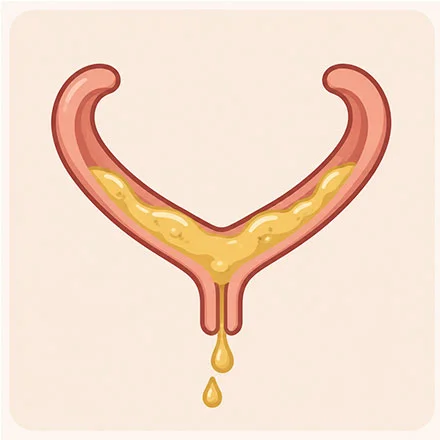
Illustrative diagram. Created by AI.
Open pyometra
The cervix is open, so pus flows outwards. You will notice vaginal discharge, often with an unpleasant odor, and the dog usually licks herself more often. Thanks to the visible discharge, this form is often diagnosed earlier.
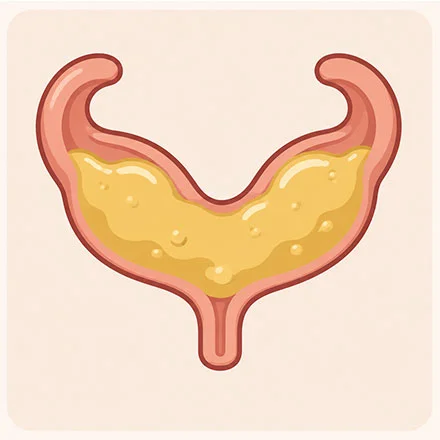
Illustrative diagram. Created by AI.
Closed pyometra
The cervix is closed, so pus has no outlet and accumulates in the uterus. The lack of discharge confuses caregivers, and the dog quickly weakens. The uterus may rupture and cause peritonitis. This is an emergency condition.
SYMPTOMS OF PYOMETRA
- increased thirst and frequent urination,
- lethargy, decreased appetite,
- vaginal discharge, often with an unpleasant odor,
- vomiting or diarrhea,
- enlarged, painful abdomen,
- fever – or conversely, hypothermia.
Symptoms usually appear within a few weeks to a few months after the heat cycle. They can affect dogs of any age, but are more common in older ones.
Go immediately if:
- the dog is very weak, lying down, not getting up,
- is vomiting and not drinking or eating,
- has pale gums or rapid breathing,
- the abdomen is rapidly enlarging, and there is no discharge.
How we treat pyometra
Pyometra is a condition where every hour counts. First, we stabilize the patient, then we operate as quickly as possible. The treatment method is always chosen by the veterinarian after examination.
Diagnostics
An abdominal ultrasound shows the uterus filled with fluid. Blood tests assess the inflammatory state and kidney function.
Stabilization
Intravenous fluids, antibiotics, and pain relief medications. If necessary, blood supply from our blood bank.
Surgery
Removal of the uterus along with the ovaries (ovariohysterectomy) under general anesthesia with full monitoring.
Medication treatment
Only in selected, stable bitches with open pyometra, e.g., breeding ones. Requires monitoring, and the disease may return.
What happens after arrival – step by step
1
Examination
We assess the general condition, hydration, temperature, and abdomen. We ask about the date of the last heat.
2
Ultrasound and blood
We confirm the diagnosis and check how the infection has affected the body.
3
Stabilization
Fluids, medications, and preparation for anesthesia – without unnecessary delay.
4
Surgery
We remove the uterus with the ovaries. Also at night and on weekends.
5
Post-operative care
The patient can remain under the clinic’s 24-hour care. The decision is made by the doctor based on her condition.
Sterilization protects against pyometra
Pyometra affects only unsterilized females. In a Swedish study of insured dogs, about one in four unsterilized bitches fell ill before the age of 10. Planned sterilization is safer than surgery on a sick, weakened bitch.
about 1 in 4
Unspayed females developed pyometra before the age of 10. years (Egenvall et al., 2001)
What you should know
- Pyometra is a serious disease. Most females operated on in time recover, but severe cases can be life-threatening.
- The most common complication is peritonitis, especially if the uterus ruptures. Therefore, it is not worth waiting if the female is feeling unwell.
- Medication does not remove the uterus – pyometra can return after the next heat cycle.
After returning home
- clothing or collar for removing stitches,
- medications exactly as prescribed, antibiotics until finished,
- leashed walks, no jumping for about 2 weeks,
- follow-up visit at the scheduled time.
Call if the female is not eating, vomiting, is weak, or if the wound is red and oozing.
Pyometra surgeries – 24 hours a day



Questions about pyometra
Is your female dog behaving differently after her heat cycle?
If in doubt, call us – we will help assess how urgent the visit is.
FAQ – questions and answers
Based on research
Jitpean S. et al. (2014), BMC Veterinary Research
Analysis of 356 bitches with pyometra: peritonitis was the most common complication after surgery, and a decreased white blood cell count was the most important warning signal. – doi: 10.1186/1746-6148-10-6 →
Egenvall A. et al. (2001), Journal of Veterinary Internal Medicine
The risk of pyometra in insured dogs in Sweden: how often do unspayed bitches get sick and which breeds are particularly at risk. – doi: 10.1111/j.1939-1676.2001.tb01587.x →
Hagman R. (2022), Veterinary Clinics of North America: Small Animal Practice
“Pyometra in Small Animals 2.0” – current review of the causes, diagnosis, and treatment of pyometra in bitches and queens. – Read the review →
Is your female dog feeling unwell after her heat? Don’t wait
Call and come in. We accept and operate 24/7.