
BOAS Surgery in Brachycephalic Dog Breeds – Gdańsk
Snoring, gasping, and quick fatigue are not a “breed charm.” It’s a sign that the dog has too little space to breathe. BOAS surgery widens the airways – we perform it with a CO₂ laser, resulting in less bleeding and swelling. The dog usually goes home the same day.

Content author: veterinarian Małgorzata Szczepańska
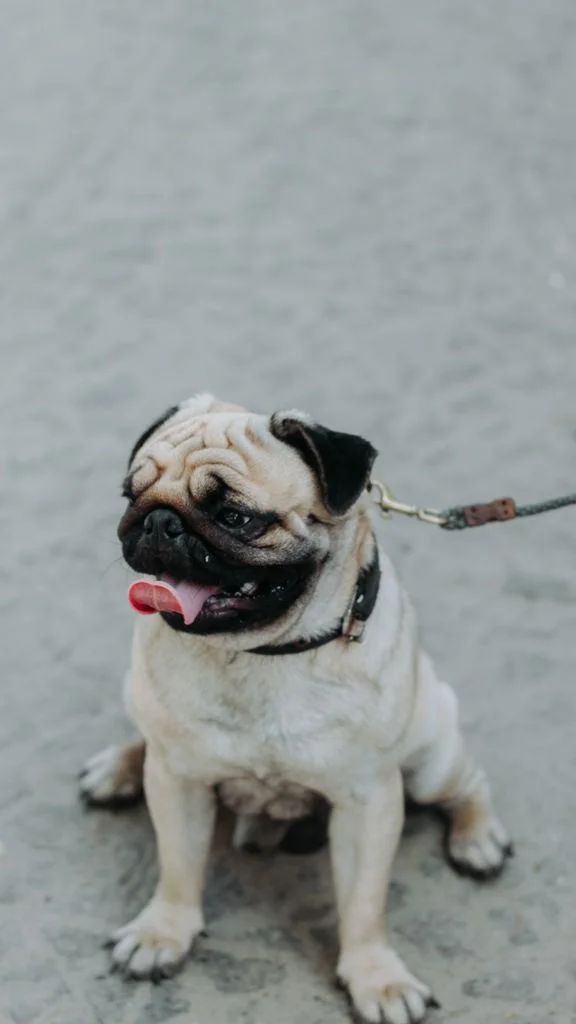
What is BOAS and what does the surgery involve?
BOAS (brachycephalic obstructive airway syndrome) is a set of structural defects: narrowed nostrils, elongated soft palate, and changes in the larynx. Because of these, the dog exerts a lot of effort with each breath.
The surgery involves widening the nostrils, shortening the soft palate, and – if necessary – removing everted laryngeal sacs. The extent of the procedure is determined by the veterinarian after examination.
Symptoms of BOAS that should not be ignored
Snoring even when not sleeping
Breathes loudly after a short walk
Gets tired quickly and overheats in the heat
Sleeps with its head raised or wakes up gasping for air
Regurgitates, chokes while eating, or vomits
Avoids movement, even though it is young and cheerful
If you recognize even one of these symptoms in your dog, it is worth scheduling a consultation.
Sometimes changes in the airways can worsen over time.
Call immediately if
- the dog is choking, has a blue or purple tongue,
- has fainted or collapsed after exertion,
- has overheated – is panting, drooling, is weak,
- is having difficulty breathing even at rest.
Cool the overheated dog with lukewarm, not icy water and come.
Where there is no room to breathe
Choose a place to see the symptoms and how urgently action needs to be taken.
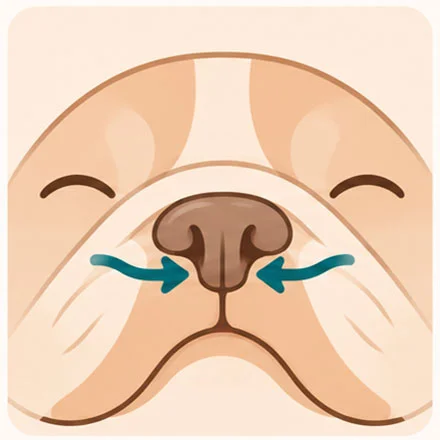
Illustrative diagram. Created by AI.
Narrowed nostrils
The nostrils collapse inward and nearly close. The dog must struggle to inhale air, often breathing through an open mouth.
How we treat
We widen the nostrils by removing a piece of tissue from the wings of the nose. This is one of the simplest stages of the operation and clearly facilitates breathing.
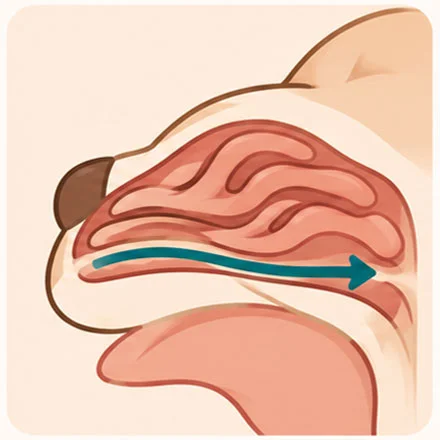
Illustrative diagram. Created by AI.
Narrow nasal cavity
In brachycephalic breeds, the nasal turbinates have little space and can narrow the airflow deep in the nose.
How we treat
The condition of the nasal cavity is assessed during diagnostics. Any further treatment is decided by the doctor after examination.
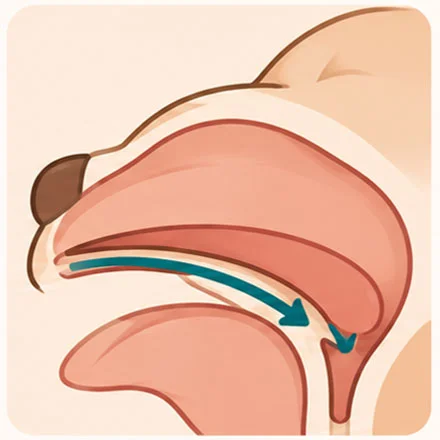
Illustrative diagram. Created by AI.
Excessively long soft palate
The soft palate is too long and thick. It hangs over the entrance to the larynx and vibrates with each breath – it is responsible for snoring.
How we treat
We shorten and slim the palate using a CO₂ laser. The laser simultaneously closes small vessels, resulting in less bleeding and swelling.
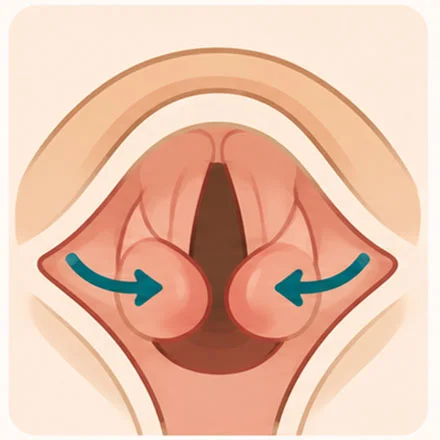
Illustrative diagram. Created by AI.
Everted laryngeal sacs
Prolonged effort in breathing pulls the laryngeal sacs into the lumen of the larynx and further narrows them. In advanced cases, the larynx may collapse.
How we treat
Everted sacs are removed during the same operation. Therefore, it is advisable to operate before changes in the larynx deepen.
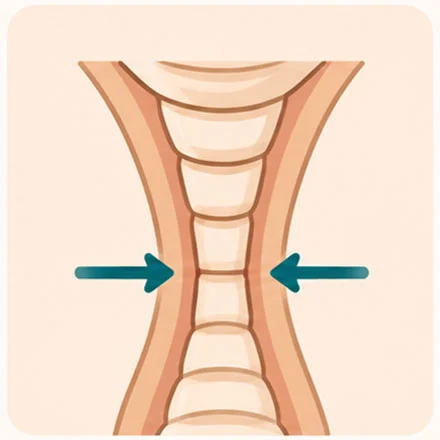
Illustrative diagram. Created by AI.
Narrow trachea
In some dogs, especially English bulldogs, the trachea is congenitally narrow.
How we treat
The trachea cannot be surgically widened. Maintaining a slim figure, avoiding overheating, and surgery on other components of BOAS helps.
Less bleeding and swelling in the throat
The throat of a brachycephalic dog is tight and well-vascularized, and any swelling after the procedure makes breathing difficult. The CO₂ laser cuts and immediately seals small vessels. In a comparative study on dogs with BOAS, the CO₂ laser resulted in shorter procedure times and less bleeding than diode lasers or electrocoagulation.
More about laser surgery →
Same-day discharge
After full awakening and assessment of breathing, the dog usually goes home the same day.
Shorter procedure
Less time spent controlling bleeding often means shorter anesthesia.
Precision
The laser removes tissue exactly where needed – in the nasal passages, on the palate, and in the larynx.
BOAS surgery step by step
Before the surgery, we carefully determine which salivary gland is the source of the cyst.
1
Consultation
We examine the dog, assess breathing at rest and after exertion, and ask about sleep, eating, and heat tolerance.
2
Qualification
Blood tests and if necessary, chest X-ray. Anesthesia plan for brachycephalic breeds.
3
Procedure
Under general anesthesia, with monitoring. The veterinarian assesses the throat and larynx and performs the planned stages with a CO₂ laser.
4
Recovery
The dog wakes up under the constant care of the team. When it breathes freely, it usually goes home the same day.
5
Check-up
Written recommendations and follow-up visit. Full recovery usually takes about 2–3 weeks.
What to know before the surgery
- The surgery clearly improves breathing but does not change the skull structure. The dog will still be a brachycephalic breed and needs to be protected from heat.
- Anesthesia in brachycephalic breeds requires special caution. Therefore, each anesthesia plan is tailored individually.
- Narrowed trachea cannot be surgically widened. This makes maintaining a slim figure even more important.
- Some dogs also experience regurgitation and vomiting. These may decrease after surgery but sometimes require treatment.
After returning home
- soft or soaked food as recommended,
- harness instead of a collar – without pressure on the neck,
- calm, cool place and short walks,
- no chew toys and tug-of-war games until the check-up.
Call immediately if the dog has difficulty breathing, is turning blue, bleeding from the nose or mouth, or is not eating.
Breeds particularly prone to BOAS
Do you have a puppy of one of these breeds? It’s worth assessing its breathing during the first visits.

Questions about BOAS surgery
Do you not know if your dog’s snoring is already a problem?
Schedule a consultation – if in doubt, we invite you.
FAQ – questions and answers
Based on research
Liu N.C. et al. (2017), Veterinary Surgery
Results and prognostic factors of surgical treatment of BOAS in pugs, French bulldogs, and English bulldogs (BOAS research team at the University of Cambridge). – doi: 10.1111/vsu.12608 →
Dunié-Mérigot A. et al. (2010), Veterinary Record
Comparison of CO₂ laser, diode laser, and electrocoagulation in shortening the soft palate in dogs with BOAS. – doi: 10.1136/vr.c5107 →
Ladlow J. et al. (2018), Veterinary Record
Review of knowledge on BOAS: symptoms, assessment of severity, and treatment options in brachycephalic dog breeds. – doi: 10.1136/vr.k1403 →
Let your dog breathe freely
Schedule a consultation. We will assess your dog’s breathing and explain whether and what surgery can help.